Collars, Cuffs, Sleeves, Noise and 100% Cotton: Honest Answers About Automatic Shirt Ironers
22 October 2026 · 8 min read
Key takeaways
- Put the shirt on damp, ideally straight after the spin cycle. If it has dried, mist it evenly first.
- Collars and cuffs come out smooth but not sharply pressed. Fold the collar up before starting, and keep an iron for a crisp point if you want one.
- Clip the hem at the front, the back and both sides so air stays in and the fabric is pulled taut.
- 100% cotton works well at the higher settings; delicate fabrics go on a lower one. Always follow the care label.
- Noise is fan noise: published figures for machines of this type range from 52 dB(A) (measured by heise on a Klarstein) to 60–64 dB (Scanovus specification).
Before buying an automatic shirt ironer, most people have the same handful of doubts. Will the collar come out right? What about the cuffs and sleeves? Do I have to iron the shirt first? Is it noisy? Here are direct answers, based on how these machines work and on what owners of several brands say in their reviews, good and bad.
How the machine actually smooths a shirt
Damp cotton is soft, and it sets in whatever shape it dries in. That is why a shirt left in a heap creases and a shirt dried on a hanger creases less. An automatic ironing machine takes this to its conclusion: the damp shirt goes on an inflatable form, warm air fills it from the inside, and the fabric dries stretched and smooth. On the Standheld this takes around 8 to 12 minutes for a shirt.
That is different from a steam iron, which presses fabric flat between a hot plate and the board, and from a handheld steamer, which relaxes creases with steam while the garment hangs loose. Pressing makes sharp lines; drying under tension makes smooth fabric without them. Keep that in mind and every answer below makes sense.
Straight from the washing machine?
Yes. A damp shirt straight from the spin cycle is ideal. Shake it out, put it on the form and do up the buttons. Two things help:
- Do not let it sit in the drum. Creases set as the shirt cools and dries in a heap.
- Not too wet. A shirt that drips takes longer. A normal spin is fine.
If the shirt has already dried, mist it evenly all over first. The Standheld Atomiser, included in both sets, is made for this. A dry, creased shirt on the machine will just become a warm, creased shirt.
Collars
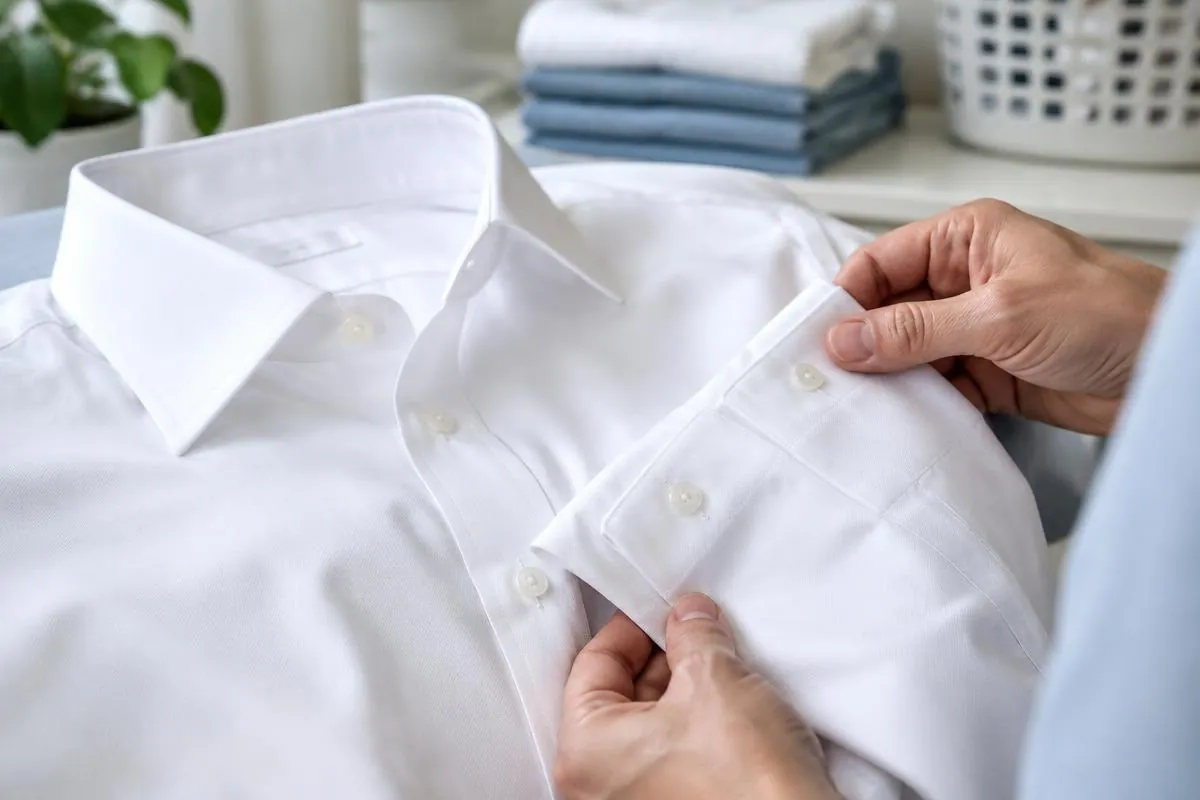
This is the most common worry in reviews of every brand. The collar dries smooth, but it is not pressed into a sharp fold. The fix is simple: fold the collar up before you start, so it stands and dries flat rather than curling against the neck of the form. If you like a crisp collar point for a formal shirt, give it a few seconds with an iron afterwards. That is still a fraction of ironing the whole shirt.
Cuffs and sleeves
On a form with inflatable sleeves, like the Standheld, the sleeves fill with warm air and dry smooth. Straighten each cuff and make sure the sleeve is not twisted around the arm of the form. On balloon-style machines, where the shirt hangs from a hanger, nothing inflates the sleeves, so they rely on the weight of the fabric to hang straight.
Clips on the hem
The clips do two jobs: they pull the fabric down so it is taut, and they stop warm air escaping from the bottom of the shirt. Put one at the front, one at the back and one on each side. On the Standheld these are the Hem Anchors, included in both sets. Without them the hem dries wavy and the cycle takes longer.
Size and fit
A loose fit is the main cause of small leftover wrinkles. If the form is too small for the shirt, open the side zips so it fills the shirt; if the shirt is slim, close them. The Standheld form adjusts up to 3XL with side zips and telescopic rods. Poor fit on larger sizes is a complaint that comes up in reviews, so check the size range and the adjustment before you buy.
100% cotton, linen and delicate fabrics
Pure cotton is where these machines earn their keep: it creases easily, but it also sets nicely as it dries under tension. Use a higher temperature for everyday cotton. Linen behaves similarly but always keeps some texture. For delicate fabrics such as silk or fine blends, use a lower temperature, and always follow the care label. The Standheld offers cool, 50, 60 and 70 °C. Wash brand-new shirts once before their first cycle, to remove the finishing from the factory.
Polos, T-shirts and jumpers also go on the form. Knits come out smooth rather than "ironed", which is usually what you want for them.
How loud is it?
The sound is the fan blowing warm air: steady, without the hiss of steam. We do not publish a measured figure for the Standheld. For comparison, the German magazine heise measured 52 dB(A) on the Klarstein ShirtButler Deluxe, and Scanovus lists 60 to 64 dB for its machine. That is roughly the range of a quiet office to a normal conversation. You can leave it running in a bedroom or a hallway while you get ready; you would not want it next to you on a video call.
Is it safe to leave running?
The Standheld switches off when the time is up, and also if it tips over or overheats. Stand it on the floor or a stable surface with clear space around it.
What reviewers of all brands criticise, honestly
Reading reviews across Scanovus, Lissaire and other brands, the same limits come up: the finish is not as crisp as a hand iron, some shirts need a quick touch on the collar or cuffs, the garment has to be damp, and results depend on getting the dampness, the temperature and the time right. The tips above address most of these. The first one does not go away: if you want knife-edge creases, you still want an iron for that last detail.
For trousers, jeans and shoes, see our step-by-step guide. To compare machines, start with our 2026 comparison.
Sources
- Klarstein ShirtButler Deluxe noise measurement by heise, via testbericht.de
- Scanovus 4.0 specifications (noise 60–64 dB)
- Review themes: Scanovus and Lissaire on Trustpilot
Frequently asked questions
Can I put a shirt on straight from the washing machine?
Yes, that is the ideal moment. The machine smooths the fabric while it dries it. A shirt that is dripping wet will need a longer cycle than one from a fast spin, so if your machine allows, use a normal spin speed for shirts.
Will the collar and cuffs be ironed?
They are dried and smoothed with the rest of the shirt, but not pressed into sharp lines. Fold the collar up before you start so it dries flat, and straighten the cuffs. For a crisp collar point, a few seconds with an iron afterwards does it.
Does it work on 100% cotton shirts?
Yes. Cotton holds creases, but it also sets in the shape it dries in, which is exactly what these machines use. Choose a higher temperature for everyday cotton, a lower one for delicate fabrics, and follow the care label.
How loud is an automatic ironing machine?
The sound comes from the fan. We do not publish a measured figure for Standheld; for comparison, heise measured 52 dB(A) on the Klarstein ShirtButler, and Scanovus lists 60–64 dB for its machine.
Can it shrink my shirts?
The highest setting on the Standheld is 70 °C, and the fabric is held taut while it dries rather than tumbling. Still, use the lower settings for delicate or synthetic fabrics and follow the care label. Wash brand-new shirts once before their first cycle.